
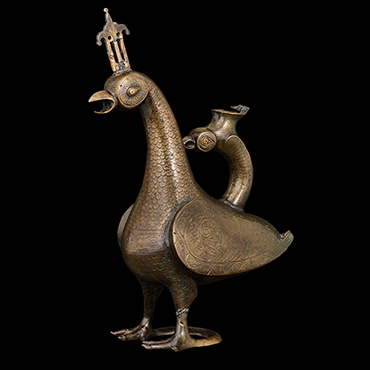
A bird of paradise
Three-dimensional large-scale sculptures from the medieval Islamic world such as this aquamanile (ewer) are extremely rare. Surviving examples consist principally of fragments in animal forms, almost always made as terminals, finials, spouts, and handles. However, large sculpted figures certainly existed in the medieval period at many courts. Visitors to the Umayyad Spanish court at Madinat al-Zahra’, for example, reported later by the historian al-Maqqari, described a huge fountain surrounded by gilded bronze animal and bird spouts. Most metal sculptures have likely been melted down over the years, and today very few survive.
This is one of three peacock aquamaniles which share common features. All three aquamaniles have a handle that is enclosed by stylized wings and terminates in a flat-sided head with protruding oval eyes that imitates the main head of the sculpture, albeit lacking the crest. The example at the Musée du Louvre in Paris is thought to be the earliest and carries a date that has been read as AH 350/962 CE or AH 361/972 CE. It is also inscribed in Kufic script “made by Abdulmalik al-Nasrani (the Christian)”. The peacock in the Pinacoteca Nazionale, Cagliari, is engraved with prominent crosses on both its breast and handle. The Furusiyya peacock was originally engraved with scrolling designs on the breast band flanking a central rosette; however, at a later date—possibly not long after its manufacture—the rosette was erased and replaced with a prominent engraved cross. While these birds were originally conceived in an Islamic context, they were subsequently used in Christian worship. Three further large Islamic bronze birds—one cockerel and two falcons, two of them with Arabic inscriptions on the breast—have similarly survived within Christian ecclesiastical institutions.
A bird of paradise
Peacock Aquamanile
Spain, 5th century AH/11th century CE
Bronze, cast and engraved, h. 35.8 × w. 24.3 cm
Furusiyya Art Foundation, R-2003